

How Do I Clean The Motor Of My Igloo Iceless Thermoelectric Cooler
Thermoelectric cooling uses the Peltier effect to create a estrus flux at the junction of 2 different types of materials. A Peltier cooler, heater, or thermoelectric heat pump is a solid-state active heat pump which transfers heat from one side of the device to the other, with consumption of electric free energy, depending on the direction of the current. Such an instrument is also called a Peltier device, Peltier rut pump, solid land refrigerator, or thermoelectric cooler (TEC) and occasionally a thermoelectric bombardment. It can be used either for heating or for cooling,[1] although in practice the main application is cooling. Information technology can also be used equally a temperature controller that either heats or cools.
This technology is far less unremarkably applied to refrigeration than vapor-compression refrigeration is. The principal advantages of a Peltier cooler compared to a vapor-compression refrigerator are its lack of moving parts or circulating liquid, very long life, invulnerability to leaks, pocket-size size, and flexible shape. Its main disadvantages are loftier toll for a given cooling chapters and poor ability efficiency (a depression COP). Many researchers and companies are trying to develop Peltier coolers that are cheap and efficient. (See Thermoelectric materials.)
A Peltier cooler can also be used as a thermoelectric generator. When operated equally a cooler, a voltage is applied beyond the device, and as a result, a difference in temperature volition build up between the two sides. When operated as a generator, one side of the device is heated to a temperature greater than the other side, and as a event, a difference in voltage volition build up between the 2 sides (the Seebeck effect). All the same, a well-designed Peltier libation will be a mediocre thermoelectric generator and vice versa, due to dissimilar design and packaging requirements.
Operating principle [edit]

Peltier element schematic. Thermoelectric legs are thermally in parallel and electrically in series.
Thermoelectric coolers operate past the Peltier consequence (1 of three phenomena that brand upwards the thermoelectric upshot). The device has two sides, and when a DC electric current flows through the device, information technology brings heat from one side to the other, so that one side gets cooler while the other gets hotter. The "hot" side is attached to a oestrus sink so that it remains at ambient temperature, while the cool side goes below room temperature. In special applications, multiple coolers tin can be cascaded or staged together for lower temperature, but overall efficiency (COP) drops significantly. The maximum COP of any refrigeration wheel is ultimately limited past the deviation between the desired (cold side) and ambient (hot side) temperature (the temperature of the heat sink). The college the temperature divergence (delta), the lower the maximum theoretical COP.
Construction [edit]
Design [edit]
Two unique semiconductors, one n-type and 1 p-type, are used because they demand to accept different electron densities. The alternate p & n-blazon semiconductor pillars are placed thermally in parallel to each other and electrically in serial so joined with a thermally conducting plate on each side, usually ceramic removing the need for a dissever insulator. When a voltage is applied to the free ends of the ii semiconductors there is a flow of DC current across the junction of the semiconductors, causing a temperature difference. The side with the cooling plate absorbs rut which is then transported by the semiconductor to the other side of the device. The cooling ability of the total unit is then proportional to the total cantankerous section of all the pillars, which are often connected in series electrically to reduce the current needed to practical levels. The length of the pillars is a residual between longer pillars, which will have a greater thermal resistance between the sides and allow a lower temperature to be reached but produce more resistive heating, and shorter pillars, which volition have a greater electrical efficiency but let more heat leak from the hot to cold side by thermal conduction. For big temperature differences, longer pillars are far less efficient than stacking separate, progressively larger modules; the modules become larger equally each layer must remove both the heat moved by the higher up layer and the waste matter estrus of the layer.
Materials [edit]

ZT values for various materials and bismuth alloys.[2]
Requirements for thermoelectric materials:[ citation needed ]
- Narrow ring-gap semiconductors considering of room-temperature operation;
- High electrical conductivity (to reduce electric resistance, a source of waste heat);
- Depression thermal electrical conductivity (so that heat doesn't come up back from the hot side to the absurd side); this usually translates to heavy elements
- Large unit cell, complex structure;
- Highly anisotropic or highly symmetric;
- Complex compositions.
Materials suitable for high efficiency TEC systems must have a combination of low thermal electrical conductivity and high conductivity. The combined effect of unlike material combinations is commonly compared using a figure of merit known as ZT, a measure of the organisation'southward efficiency. The equation for ZT is given below, where alpha is the Seebeck coefficient, sigma is the electrical electrical conductivity and kappa is the thermal conductivity.[3]

There are few materials that are suitable for TEC applications since the relationship betwixt thermal and conductivity is ordinarily a positive correlation. Improvements in reduced thermal send with increased electrical conductivity are an active area of fabric scientific discipline inquiry. Common thermoelectric materials used equally semiconductors include bismuth telluride, atomic number 82 telluride, silicon germanium, and bismuth-antimony alloys. Of these, bismuth telluride is the nearly commonly used. New high-performance materials for thermoelectric cooling are being actively researched.
The working elements must be in an isolated casing, and the best geometry is a plane. Normally this will be them being sandwiched betwixt a pair of ceramic plaques, sealed (or non).
Identification and characteristics [edit]

Peltier elements all conform to a universal identification specification
The vast majority of thermoelectric coolers take an ID printed on the cooled side.[4]
These universal IDs conspicuously point the size, number of stages, number of couples, and electric current rating in amps, as seen in the adjacent diagram.[5]
Very common Tec1-12706, square of 40 mm size and 3–4 mm high, are found for a few dollars, and sold every bit able to move effectually 60 West or generate a 60 °C temperature difference with a half-dozen A current. Their electrical resistance volition exist of 1–2 ohm magnitude.
Strengths and weaknesses [edit]
In that location are many factors motivating further research on TEC including lower carbon emissions and ease of manufacturing. Still, several challenges have arisen.
Benefits [edit]
A significant benefit of TEC systems is that they have no moving parts. This lack of mechanical wear and reduced instances of failure due to fatigue and fracture from mechanical vibration and stress increases the lifespan of the system and lowers the maintenance requirements. Current technologies prove the mean fourth dimension betwixt failures (MTBF) to exceed 100,000 hours at ambient temperatures.[6]
The fact that TEC systems are current-controlled leads to another serial of benefits. Considering the period of heat is straight proportional to the practical DC current, heat may be added or removed with accurate control of the direction and corporeality of electrical electric current. In contrast to methods that use resistive heating or cooling methods that involve gasses, TEC allows for an equal caste of control over the menstruum of heat (both in and out of a organization under control). Because of this precise bidirectional heat flow command, temperatures of controlled systems can be precise to fractions of a degree, ofttimes reaching precision of milli Kelvin (mK) in laboratory settings.[7] TEC devices are likewise more flexible in shape than their more traditional counterparts. They can be used in environments with less space or more severe atmospheric condition than a conventional refrigerator. The ability to tailor their geometry allows for the delivery of precise cooling to very small areas. These factors make them a common choice in scientific and engineering applications with demanding requirements where cost and accented energy efficiency are not main concerns.
Another benefit of TEC is that information technology does not apply refrigerants in its operation. Prior to their phaseout some early refrigerants, such as chlorofluorocarbons (CFCs), contributed significantly to ozone depletion. Many refrigerants used today also have meaning ecology impact with global warming potential[8] or carry other prophylactic risks with them.[9]
Disadvantages [edit]
TEC systems have a number of notable disadvantages. Foremost is their limited free energy efficiency compared to conventional vapor-compression systems and the constraints on the total rut flux (heat flow) that they are able to generate per unit area.[vii] This topic is further discussed in the performance section below.
Performance [edit]
Peltier (thermoelectric) performance is a function of ambient temperature, hot and cold side heat exchanger (rut sink) performance, thermal load, Peltier module (thermopile) geometry, and Peltier electrical parameters.[4]
The amount of oestrus that can be moved is proportional to the current and time.
- , where P is the Peltier coefficient, I is the current, and t is the fourth dimension. The Peltier coefficient depends on temperature and the materials the cooler is fabricated of. Magnitude of 10 watt per ampere are common, but this is offset past 2 phenomena:

- According to Ohm's law, a Peltier module will produce waste matter rut itself,
- , where R is the resistance.
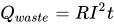
- Heat will besides motion from the hot side to the cool side past thermal conduction inside the module itself, an effect which grows stronger equally the temperature difference grows.
The result is that the heat effectively moved drops as the temperature difference grows, and the module becomes less efficient. There comes a temperature difference when the waste matter heat and heat moving back overcomes the moved heat, and the module starts to heat the cool side instead of cooling information technology further. A single-stage thermoelectric cooler will typically produce a maximal temperature divergence of 70 °C between its hot and cold sides.[10]
Another consequence with operation is a straight consequence of one of their advantages: being modest. This means that:
- the hot side and the cool side will be very shut to each other (a few millimeters abroad), making it easier for the estrus to become back to the cool side, and harder to insulate the hot and absurd side from each other
- a common twoscore mm × 40 mm can generate 60 W or more, that is, 4 Westward/cm2 or more, requiring powerful radiator to move the heat way
In refrigeration applications, thermoelectric junctions have nigh 1/4 the efficiency (COP) compared to conventional (vapor compression refrigeration) ways: they offer around x–15% efficiency of the ideal Carnot cycle refrigerator, compared with xl–60% accomplished by conventional compression-cycle systems (contrary Rankine systems using pinch/expansion).[xi] Due to this lower efficiency, thermoelectric cooling is generally only used in environments where the solid-state nature (no moving parts), low maintenance, compact size, and orientation insensitivity outweighs pure efficiency.
While lower than conventional means, efficiency can be good enough, provided:
- temperature difference is kept as small as possible, and,
- the current is kept low, because the ratio of moved estrus over waste matter oestrus (for aforementioned temperature on the hot and cool side) will be .
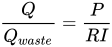
Withal, since low current also means a low amount of moved estrus, for all applied purposes the coefficient of functioning volition be low.
Uses [edit]

A USB-powered beverage cooler
Thermoelectric coolers are used for applications that require heat removal ranging from milliwatts to several m watts. They can exist fabricated for applications as small as a beverage cooler or equally large as a submarine or railroad car. TEC elements have express life time. Their health force can be measured past the change of their AC resistance (ACR). As a cooler element wears out, the ACR volition increase.[ citation needed ]
Consumer products [edit]
Peltier elements are commonly used in consumer products. For example, they are used in camping, portable coolers, cooling electronic components and small instruments. They tin besides be used to extract h2o from the air in dehumidifiers. A camping ground/automobile blazon electric libation can typically reduce the temperature past upwards to twenty °C (36 °F) below the ambient temperature, which is 25 °C if the car reaches 45 °C under the sunday. Climate-controlled jackets are outset to use Peltier elements.[12] [13] Thermoelectric coolers are used to broaden estrus sinks for microprocessors.
Industrial [edit]
Thermoelectric coolers are used in many fields of industrial manufacturing and require a thorough operation assay as they face the examination of running thousands of cycles before these industrial products are launched to the market place. Some of the applications include laser equipment, thermoelectric air conditioners or coolers, industrial electronics and telecommunication,[fourteen] automotive, mini refrigerators or incubators, military cabinets, Information technology enclosures, and more.
Science and imaging [edit]
Peltier elements are used in scientific devices. They are a common component in thermal cyclers, used for the synthesis of Dna by polymerase concatenation reaction (PCR), a common molecular biological technique, which requires the rapid heating and cooling of the reaction mixture for denaturation primer annealing and enzymatic synthesis cycles.
With feedback circuitry, Peltier elements tin be used to implement highly stable temperature controllers that proceed desired temperature within ±0.01 °C. Such stability may be used in precise laser applications to avoid laser wavelength globe-trotting as surround temperature changes.
The outcome is used in satellites and spacecraft to reduce temperature differences acquired by directly sunlight on ane side of a craft by dissipating the heat over the cold shaded side, where information technology is prodigal as thermal radiation to space.[fifteen] Since 1961, some unmanned spacecraft (including the Marvel Mars rover) utilise radioisotope thermoelectric generators (RTGs) that convert thermal energy into electrical energy using the Seebeck effect. The devices tin last several decades, as they are fueled by the decay of high-free energy radioactive materials.
Peltier elements are also used to make cloud chambers to visualize ionizing radiation. Only by passing an electric current, they can cool vapors below −26 °C without dry water ice or moving parts, making cloud chambers easy to make and use.
Photon detectors such as CCDs in astronomical telescopes, spectrometers, or very high-terminate digital cameras are often cooled by Peltier elements. This reduces nighttime counts due to thermal noise. A night count occurs when a pixel registers an electron caused by thermal fluctuation rather than a photon. On digital photos taken at depression low-cal these occur as speckles (or "pixel noise").[ citation needed ]
Thermoelectric coolers can exist used to cool figurer components to keep temperatures within blueprint limits or to maintain stable functioning when overclocking. A Peltier cooler with a heat sink or waterblock can cool a bit to well below ambience temperature.[16]
In cobweb-optic applications, where the wavelength of a laser or a component is highly dependent on temperature, Peltier coolers are used forth with a thermistor in a feedback loop to maintain a constant temperature and thereby stabilize the wavelength of the device.
Some electronic equipment intended for war machine utilize in the field is thermoelectrically cooled.[ citation needed ]
See also [edit]
- Thermoacoustics
- Thermotunnel cooling
References [edit]
- ^ Taylor, R.A.; Solbrekken, One thousand.L. (2008). "Comprehensive system-level optimization of thermoelectric devices for electronic cooling applications". IEEE Transactions on Components and Packaging Technologies. 31: 23–31. doi:10.1109/TCAPT.2007.906333. S2CID 39137848.
- ^ DiSalvo, Francis (July 1999). "Thermoelectric Cooling and Power Generation". Science. 285 (5428): 703–6. doi:ten.1126/science.285.5428.703. PMID 10426986.
- ^ Poudel, Bed (May 2008). "High-Thermoelectric Performance of Nanostructured Bismuth Antimony Telluride Bulk Alloys". Scientific discipline. 320 (5876): 634–eight. Bibcode:2008Sci...320..634P. doi:10.1126/science.1156446. PMID 18356488. S2CID 206512197.
- ^ a b "PCB Heaven – Peltier Elements Explained". PCB Sky. PCB Sky. Retrieved 1 May 2022.
- ^ Versteeg, Owen. "Peltier Element Identification". Retrieved 14 October 2022.
- ^ Ghoshal, Uttam (2001-07-31). "Highly reliable thermoelectric cooling apparatus and method". patents.google.com . Retrieved 2019-03-12 .
- ^ a b Zhao, Dongliang (May 2022). "A review of thermoelectric cooling: Materials, modeling and applications". Applied Thermal Engineering. 66 (one–2): 15–24. doi:10.1016/j.applthermaleng.2014.01.074.
- ^ University of California (April 18, 2022). "Chlorofluorocarbons and Ozone Depletion". American Chemical Society . Retrieved 2019-03-eleven .
- ^ "Module 99: Propane every bit a refrigerant for use in chillers for ac applications". CIBSE Journal. September 2022. Retrieved 2020-01-22 .
- ^ "The Heatsink Guide". Retrieved 3 May 2022.
- ^ Dark-brown, D. R.; Northward. Fernandez; J. A. Dirks; T. B. Stout (March 2022). "The Prospects of Alternatives to Vapor Compression Engineering for Space Cooling and Food Refrigeration Applications" (PDF). Pacific Northwest National Laboratory (PNL). U.S. Department of Energy. Retrieved 16 March 2022.
- ^ Hsu, Jeremy (2011-06-14). "Cold? Put this jacket on. Hot? Put this jacket on Climate-controlled coat goes from naught to 100 degrees C 'in the flip of a button'". NBC News. NBC. Retrieved 16 March 2022.
- ^ Ferro, Shaunacy (2013-03-15). "How Winter Woes Inspired A Nanotech Fix For Everything From Cold Necks To Genu Pain". Popular Mechanics. Bonnier Corp. Retrieved sixteen March 2022.
- ^ Using Peltier modules for thermal management of electronic systems. Electronics Weekly, 4 October 2022
- ^ Kotlyarov, Evgeny; Peter de Crom; Raoul Voeten (2006). "Some Aspects of Peltier-Cooler Optimization Applied for the Glove Box Air Temperature Control". SAE International. SAE Technical Paper Series. 1: one. doi:x.4271/2006-01-2043.
- ^ Fylladitakis, Eastward. (September 26, 2022) The Phononic HEX 2.0 TEC CPU Cooler Review. Anandtech.com. Retrieved on 2022-10-31.

Source: https://en.wikipedia.org/wiki/Thermoelectric_cooling
Posted by: smithsamphy.blogspot.com
0 Response to "How Do I Clean The Motor Of My Igloo Iceless Thermoelectric Cooler"
Post a Comment